


upper safe zone
Solo project: Backgammon remake
The Backgammon board
lower safe zone

This project is a digital adaptation of the game Backgammon, featuring rule variations. My goal was to use a game with well-established rules in order to implement modifications without distorting its essence.
upper safe zone
Project overview
This project was carried out as part of my fourth year of studies at Piktura. Over the course of five months, I worked on a new version of Backgammon using Unreal Engine 5. This was my first project using this engine, and recreating the game itself was a challenge. In parallel, I designed new rules and added a more concrete thematic setting to the game.
Production time: 5 months half-time
Genre: turn-based strategy
Engine: blueprints and Unreal Engine 5
Number of players: 2
lower safe zone
upper safe zone
Why this game and its origins

The Seventh Plague, painting by John Martin (1789-1854), exhibited at the Fine Arts Museum, Boston, Massachusetts
I chose this game because it is relatively unknown to the general public, unlike chess or poker, which already have many existing variations.
Moreover, its structure and rules were the main reasons that inspired me to select this game over others.
At the very beginning of the project, I also conducted some research on the origins of Backgammon. I learned that early versions, which vaguely resemble today's game, were found in the Egyptian pyramids. The game has undergone numerous name changes and rule variations, such as the Royal Game of Ur, Senet, the Game of 12 Lines, and Tabula. It was ultimately in England, around the 16th century, that the game became known as Backgammon.
Its ancient origins directly inspired me when choosing the thematic setting for my version.
lower safe zone
upper safe zone
Intentions
Throughout the process, I aimed to preserve the essence of the original game while adding additional rules and a new setting: Ancient Egypt.
This choice came naturally thanks to my earlier research on the game's origins. Additionally, Ancient Egypt is a rich historical period that greatly interests me.
lower safe zone
upper safe zone
Rules: a quick reminder
Backgammon is a two-player game of contrary movement in which each player has fifteen pieces known traditionally as men (short for 'tablemen'). The backgammon table pieces move along twenty-four 'points' according to the roll of two dice. Backgammon involves a combination of strategy and luck from rolling dice. While the dice may determine the outcome of a single game, the better player will accumulate the better record over a series of many games. With each roll of the dice, players must choose from numerous options for moving their pieces and anticipate possible counter-moves by the opponent.
Goal
Two players compete to be the first to complete the 24 arrows on the board with their 15 checkers, while preventing their opponent from progressing in an organized retreat.
Gameplay
The roll of the dice determines how players can move their pieces
Game over
Once one player has removed all his pieces from the board, he is declared the winner
lower safe zone
upper safe zone
Remake of the game
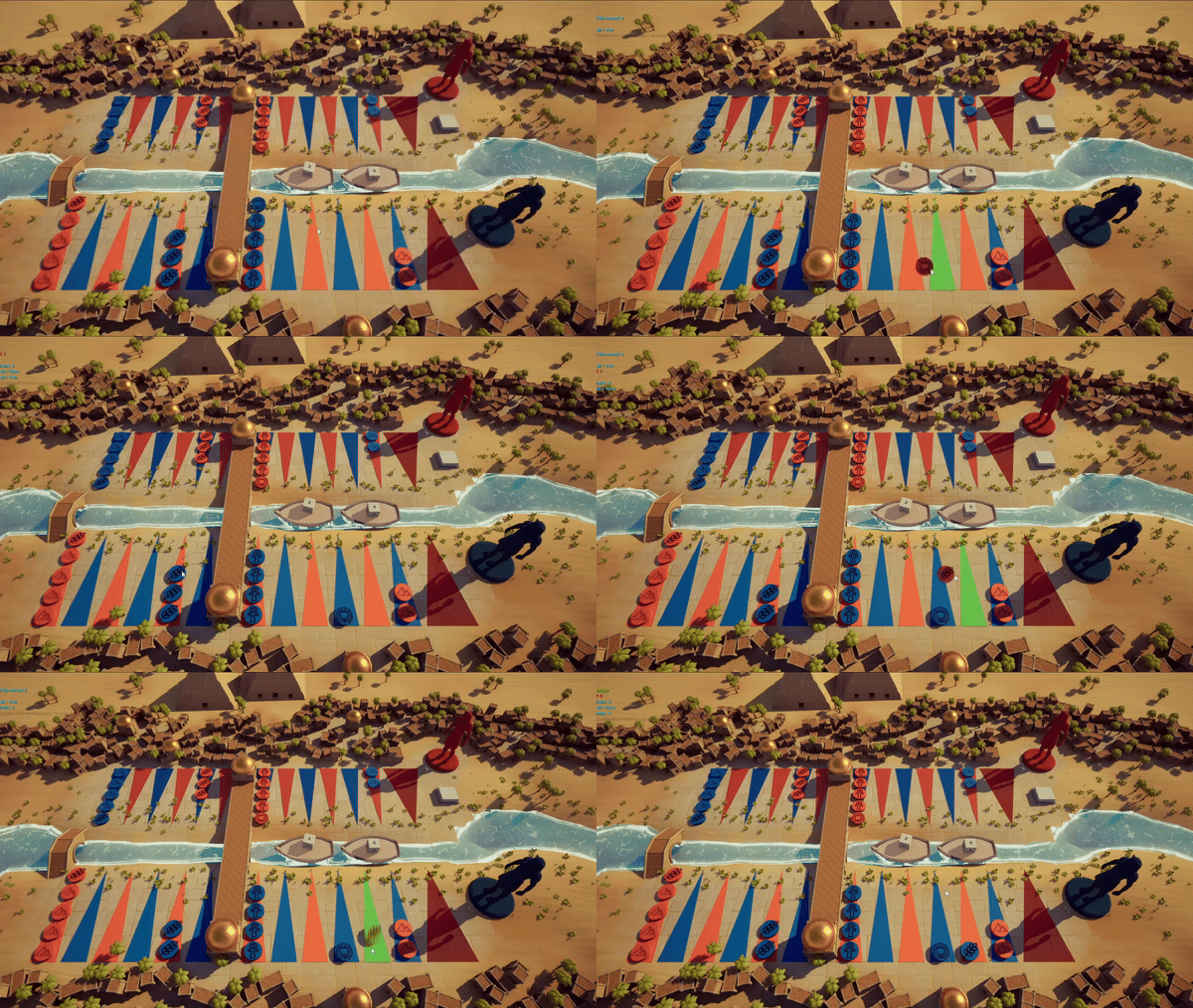
Footage of my prototype made on Unreal Engine 5
The main technical task of this project was to recreate the game using Unreal Engine 5. The rules of Backgammon are not particularly complex, but they do involve many specific cases to consider. This allowed me to experiment extensively with blueprints, helping me maintain organized and clean code to facilitate the addition of new rules without too much difficulty.
Additionally, it was necessary to manage each component and the game flow to ensure compatibility for two players, adding an extra layer of work. Unlike the physical game, where the players act as their own referees, the digital version requires limiting players' actions to enforce the rules. Identifying these limitations and implementing them in the code was essential.
In hindsight, I would say that I underestimated the time needed to recreate the game, and I ultimately did not have enough time to integrate all the rules I had planned to add.
lower safe zone
upper safe zone
Objectives of the additional rules
Before defining the rules I wanted to add, I first set some guidelines to steer the project in a clear direction and avoid spreading myself too thin or getting lost.

Firstly, I want to give players the ability to control certain aspects of randomness during the game, allowing them to place their pieces according to a strategic plan.

Secondly, I aim to enhance the players' choices in placing their pieces on the board by introducing additional elements that build on the basic game strategy.
lower safe zone
upper safe zone
N°1: the protection of the gods

Fresco depicting the pharaoh (left) and Anubis (right)
At the beginning of the game, each player chooses a god as their protector. These gods, inspired by Egyptian mythology, grant players a one-time-use power available throughout the match, similar to a faction in a strategy game.
This rule introduces potential game-changing moments, affecting piece placement, dice results, or other game variables.
The vast array of Egyptian gods also provides inspiration for unique powers.
Here is a few examples of powers linked to a specific god in the Egyptian mythology.

Anubis, the god of mummies
When a piece is removed from the bar, the player places it freely on one of the first 6 arrows on the board.

Ptah, the god of craftsmen
Two slaves may leave the board before the vizier.

Horus, the pharaoh's protector
Immediately removes a plague from the board.

Seth, the evil god
Sends a single piece to the bar.

Ra, the protecting god
The player can use his power to protect 2 pawns for 5 turns. A protected piece cannot be sent to the bar if it is alone on an arrow.

Amon, a powerful and mysterious god
During a double, the player can make 6 moves instead of 4.
lower safe zone
upper safe zone
N°2: social castes

Egyptian social organization pyramid
As Pharaohs, each player must protect their people from the plagues afflicting Egypt. I was inspired by the strict vertical hierarchy of ancient Egyptian society to create four categories of pieces:
-
The Vizier
-
The Priests
-
The Peasants
-
The Slaves
To win the game, players must follow a specific order to remove their pieces from the board. Each piece has a different weight, influencing the players' decisions.
For example, if the Vizier is captured and sent back to the start, the player experiences a significant setback. Thus, certain pieces must be protected, even at the risk of losing others.
lower safe zone
upper safe zone
N°3: influential districts

Facade of the Coptic Museum, Cairo, Egypt
Continuing with the idea of influencing the movement of the players' pieces, I assigned unique characteristics to certain tiles on the board.
These special tiles , placed asymmetrically on the board, provide bonuses to the player who controls them by meeting specific conditions, such as the number of pieces on the arrow. The placement of these tiles and the corresponding bonuses were determined by analyzing numerous games to identify recurring patterns. Thus, they can either block a combination or amplify its effects.
These bonuses affect the randomness of the game to support players in executing their strategies. However, they are only temporary, as players cannot keep their pieces in the same spot indefinitely to win the game.
lower safe zone
upper safe zone
N°4: plagues

Sketch after Turner's 'The Fifth Plague of Egypt', by 1868, John Homes Smith (1797 - 1868)
Lastly, I added an event system to add rhythm to the game. I was inspired by the Ten Plagues of Egypt mentioned in the Old Testament. Of course, not all of them are suitable for a board game of this type, as their effects must be represented in a way that is understandable to the players.
I selected four of them:
-
The Hailstorm
-
The Locust Invasion
-
The Transformation of the Nile’s Water into Blood
-
Total Darkness
A new plague appears on the board periodically, on a randomly chosen tile. They negatively affect the pieces of both players without distinction but only remain on the board for a limited time. Additionally, there can be no more than two plagues on the board at the same time to avoid creating excessive frustration for the players by hindering their strategy without giving them a chance to respond.
Here is the effects for each of the plagues.
The Hailstorm
No pawn may go onto this tile for the duration of the plague.
Send all pawns on this tile to the bar immediately.
The Locust Invasion
The movement of counters from a tile affected by this plague is reduced to 1.
The Transformation of the Nile’s Water into Blood
The movement of counters from a tile affected by this plague is reduced by 1.
Total Darkness
No pawn can move to this tile for the duration of the plague.
No piece can move from this tile for the duration of the plague.
lower safe zone
upper safe zone
Interface
The final step is to design an interface to inform players of the game’s current state.
This interface must display key information, such as whose turn it is and how much time remains until the next plague appears.
I created an initial mockup of the final interface, but it may evolve depending on the project's needs. This already helps to better visualize the final result.
Frieze and lap counter

Current player
Remaining pieces moves
Remaining plague time
lower safe zone
Post mortem
Lack of playtesting for the new rules to verify their functionality
I learned Unreal Engine
I learned how to modify a concept while preserving its core rules
I gained experience in task estimation and delivering within deadlines