


Game designer for Pakke-Is
You play as Nuna, a young Inuit girl who is set to explore and hunt sea animals possessed by an evil spirit during the prehistoric era in the north of Canada.
Project overview
The team:
-
2 game designers
-
3 game artists
-
2 game programmers
Production time: 6 months half-time
Genre: action-adventure
Engine: Unity
Number of players: 1
My role
During the production of Pakke-Is, I worked on all aspects of game design and was also responsible for project management.
I was involved in the design of 3Cs, gameplay loops, gameplay elements and the experience system, but my main task was level design.
Pre-production process
Research into level design
I've played and studied games whose world-building matches our intentions, such as Brothers - A Tale of Two Sons (2013) and certain passages of God of War (2022), and I've researched and analyzed various resources dealing with level design, such as GDC conferences and Youtube videos.
Sources of inspiration to help brainstorm
To best render the ice floe environment, I did extensive research into the shapes and sizes of icebergs and the many different environments offered by the ice floe.
Production of support documents
Before producing levels directly, I produced documents to guide me, such as a pacing chart to gauge difficulty, a timeline to divide the game time into distinct sequences, and a table to sort out the intentions, key features, flow and atmosphere of each sequence. All this helps me to stay on track and maintain the coherence of the world I'm creating.
Process
Research and testing
I found sources of inspiration in the same universe, and tried out different methods for building the level, considering technical constraints (optimisation, time available, etc.).
Design
Using the supporting documents (pacing, intentions, features, narratives), design the game levels to meet expectations.
Feedback
Test the level regularly to obtain feedback on specific aspects and improve certain elements (navigation, orientation, staging).
The avatar and its abilities
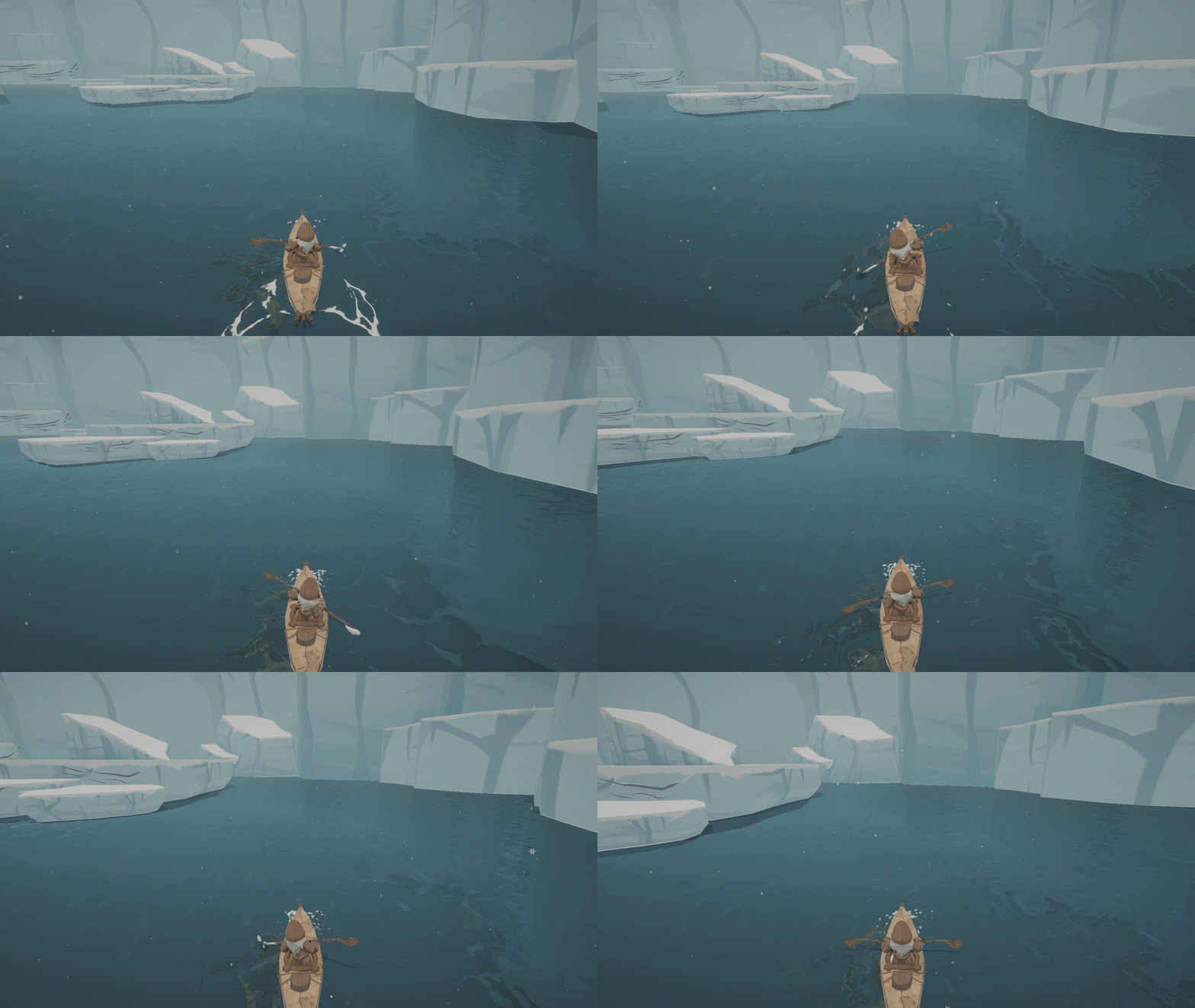
To briefly summarize what the player can do in Pakke-Is, he controls a kayak from which he will not leave for the duration of the demo. Control is realistic, so the player moves the kayak forward alternately pressing the triggers.
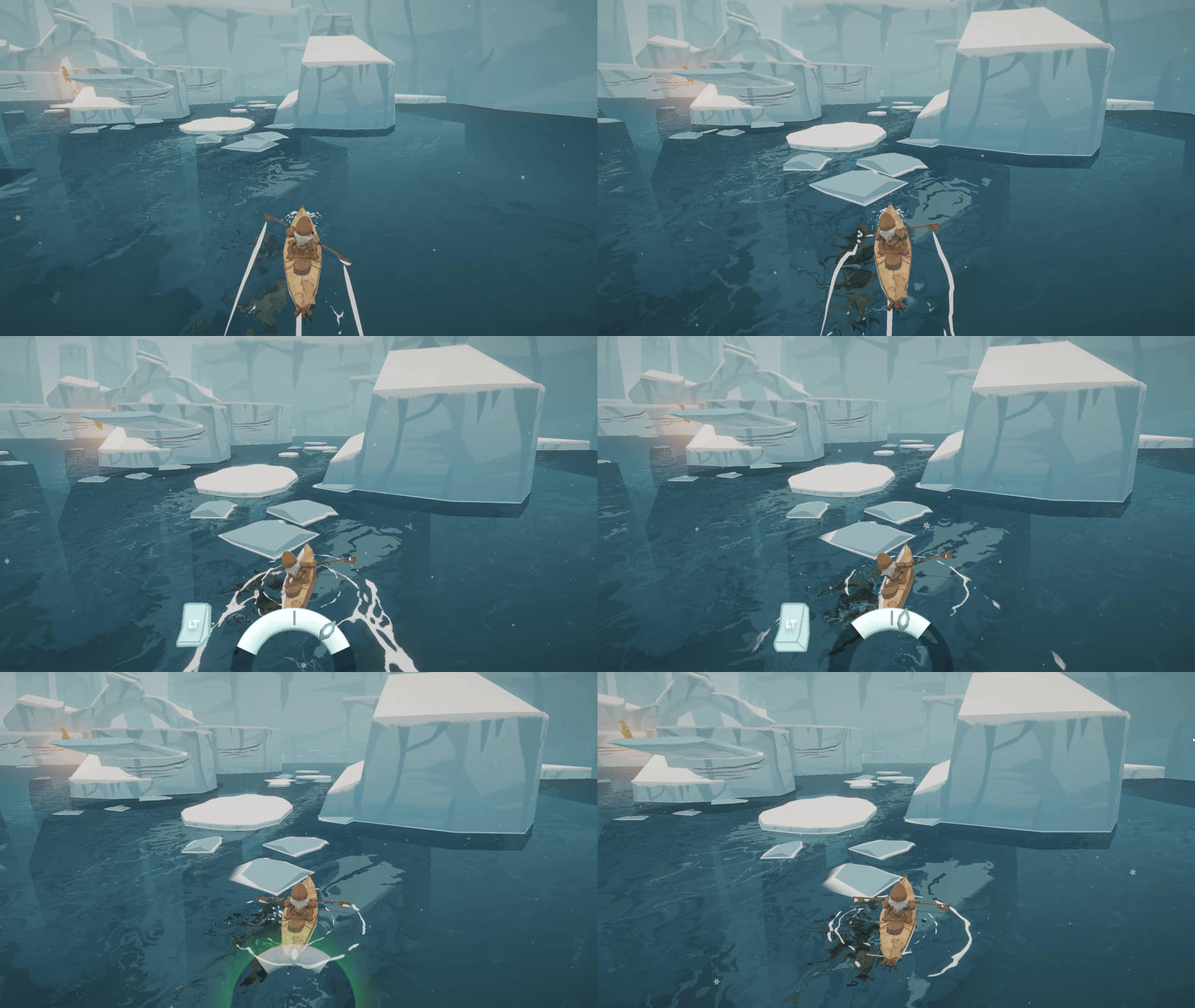
The main challenge is to keep the kayak balanced. If the avatar falls into the water, it's game over. To avoid this, the player has to press repeatedly and quickly the trigger on the opposite side of the way to return to a more stable position.
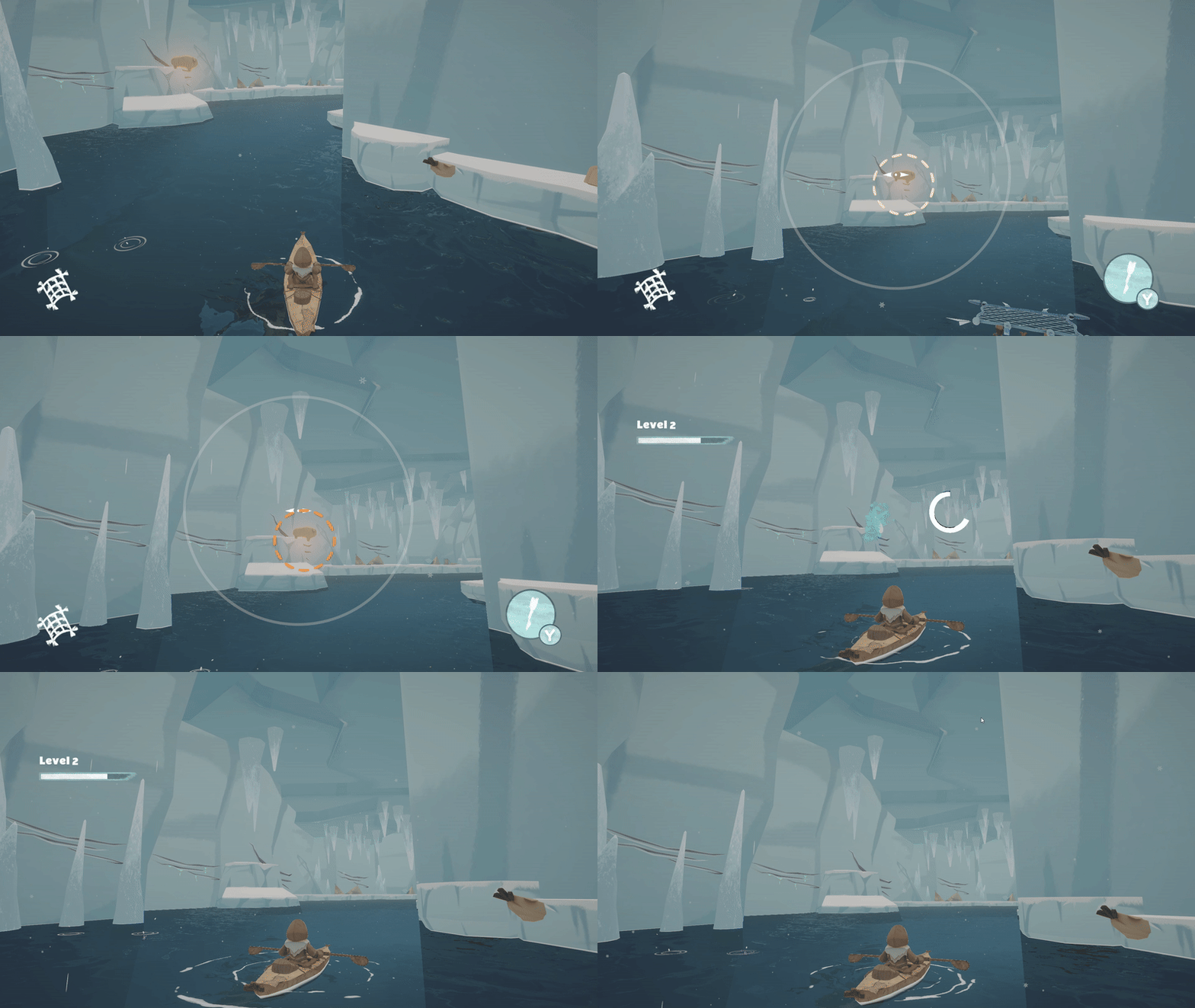
Finally, thanks to tools that the player unlocks as he goes along, he can collect collectables or cure animals of their curse.
A linear level
The main challenge when designing a level in an ice floe is to steer the player in the desired direction. After a few tests of blocking, the solution of making a linear level is more appropriate to avoid the player getting lost in an overly uniform setting. To help the player find his bearings, the mood of the level changes from a foggy morning to a clear evening.
How to break the regularity

The similarity of the icebergs could often cause the player to get lost. To avoid this, adding iceberg markings, variations in their height and shape, and certain gameplay elements makes each segment more unique.
Guiding the player

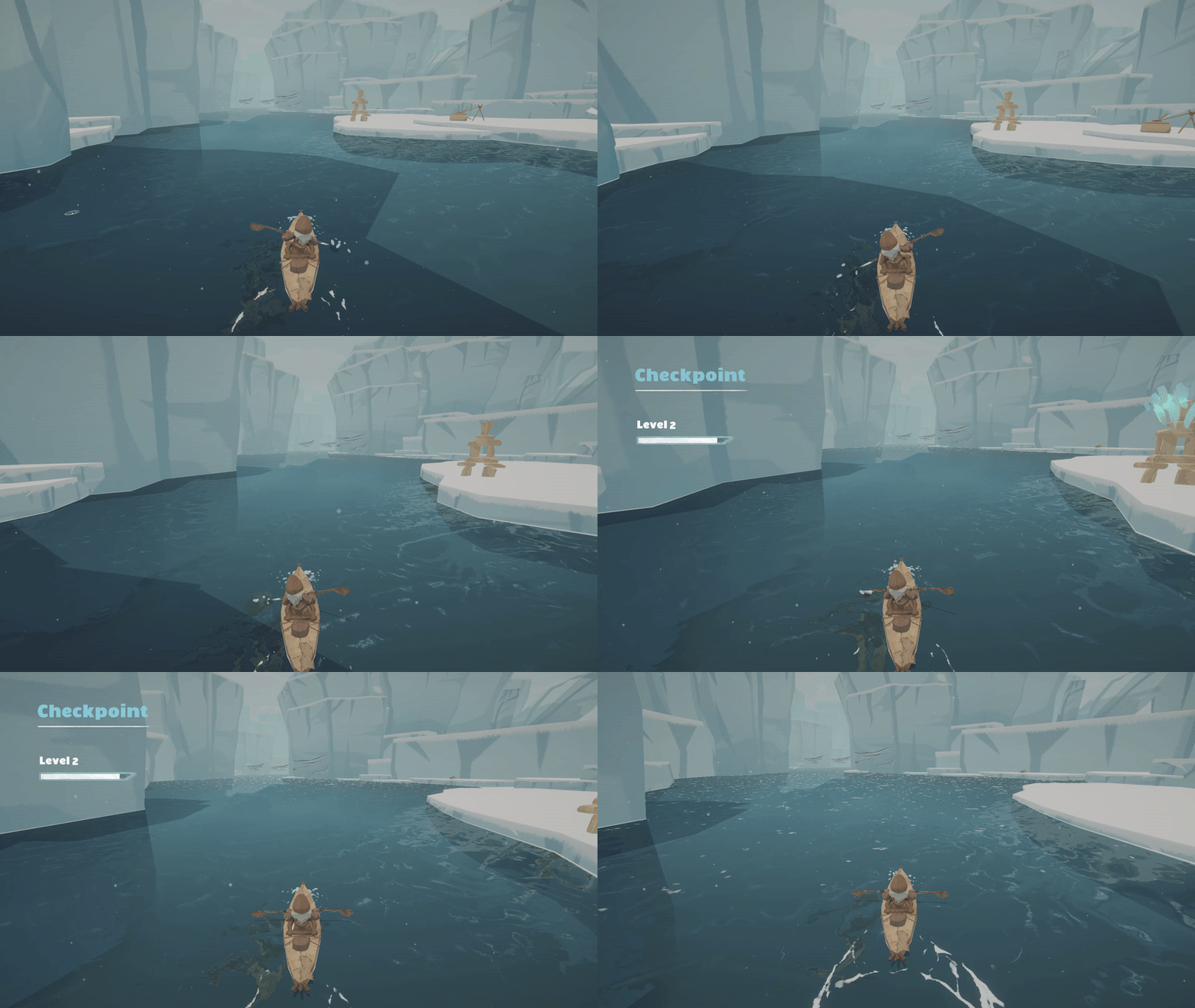
To steer the player in the right direction, checkpoints mark the player's progress. Sea currents can carry the player in one direction, serving both to keep the player moving in the right direction, but also as challenges in their own right, as the player is more likely to lose balance.
Using the camera to change the player's point of view and focus on a particular element makes orientation more intuitive.
Enemy integration
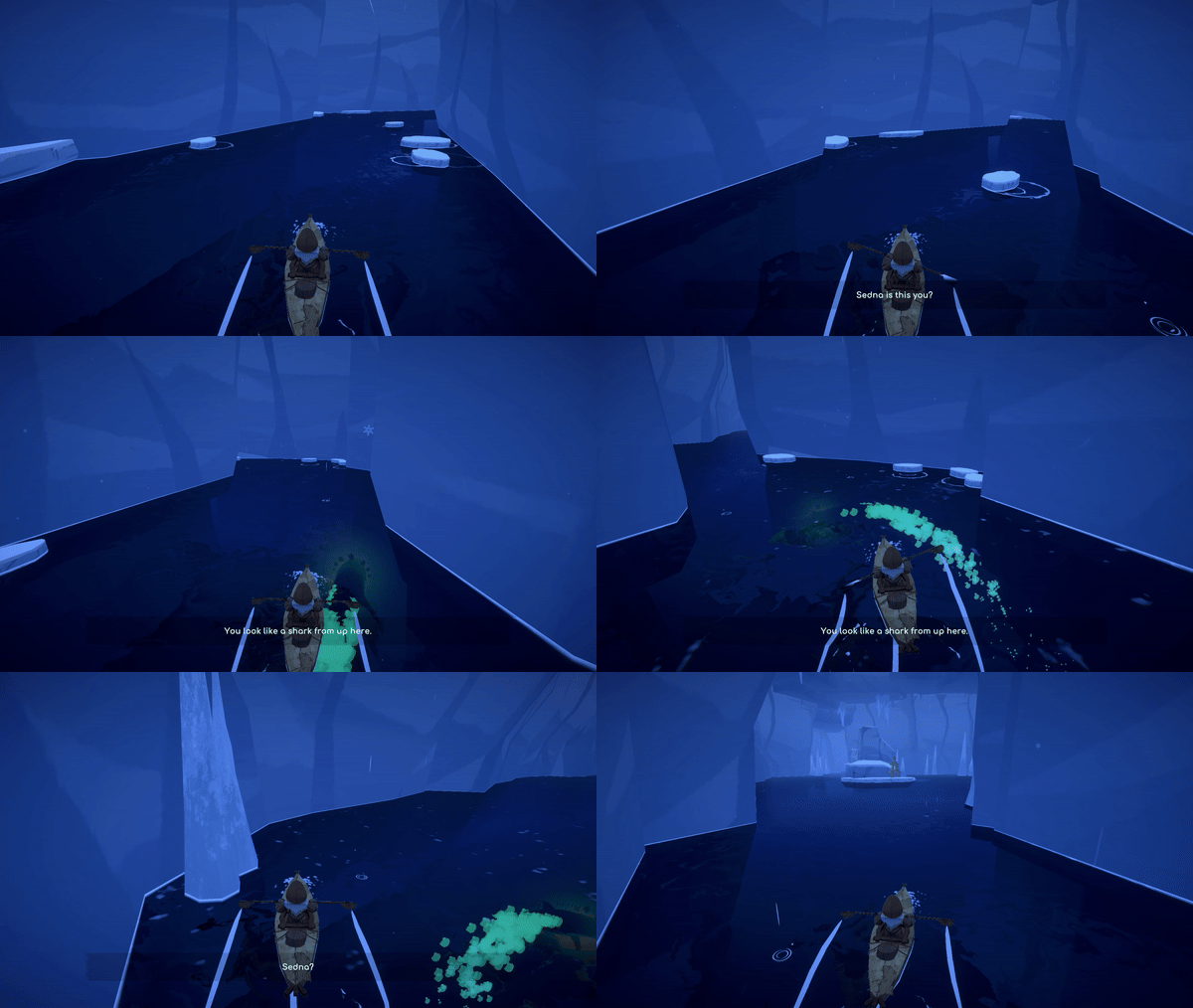
To match our gameplay and narrative intentions, confrontations with enemies are rare, the aim is to make them more memorable by concentrating on their staging. For example, before fighting the seal, the player will chase it while avoiding falling icebergs. At another point in the demo, the player encounters a shark, but the shark doesn't attack the player until later, this first encounter serving only to create tension for the player.
Finally, the environments in which the player confronts the seal and the shark are very different, and the resulting interactions vary greatly.
Adding extra features at the expense of the project
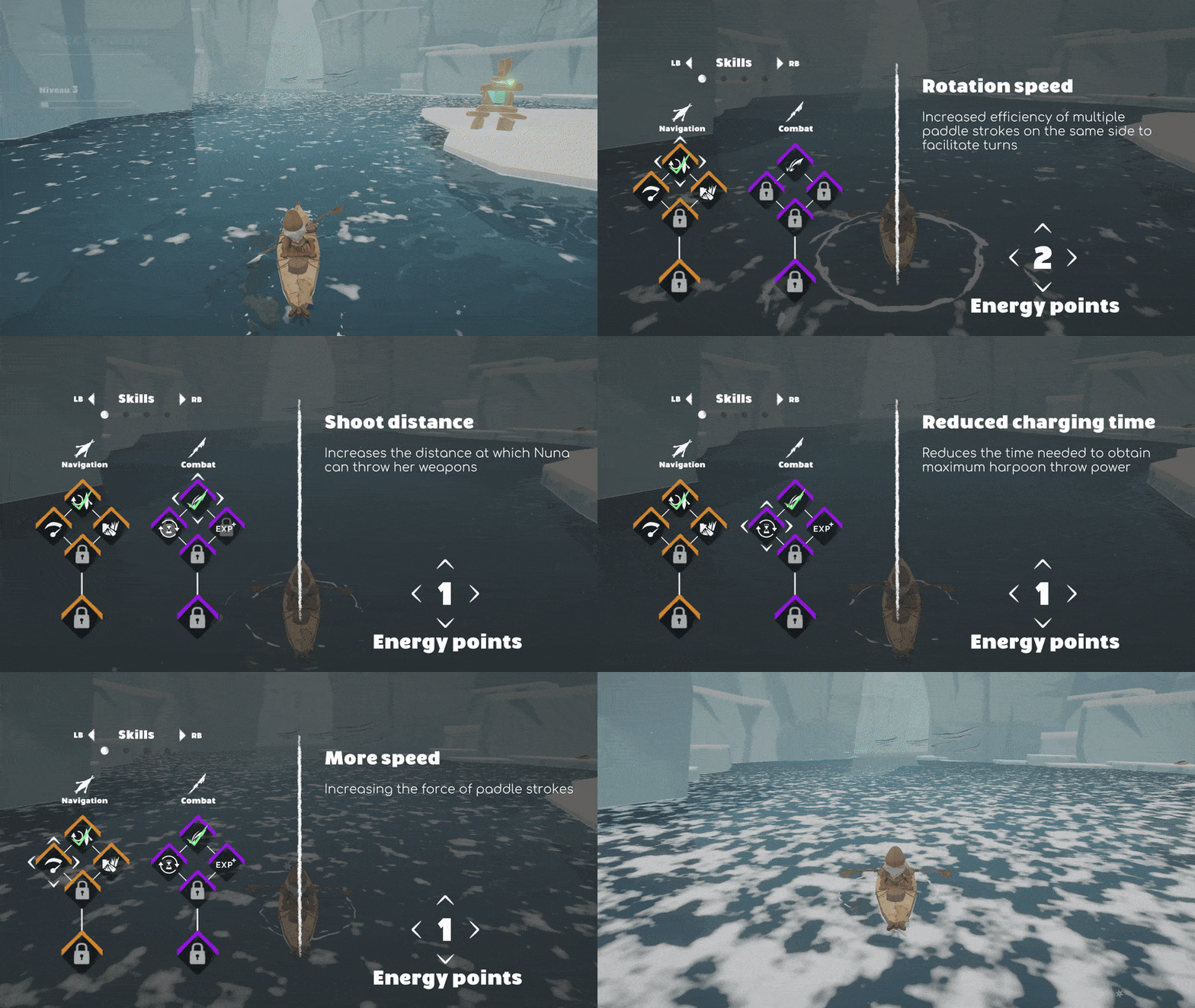
One of my main mistakes in this project was attempting to add an extra feature at the end of the production phase instead of continuing to improve the staging and the player controller. I suggested to the team the addition of a skill tree that the player could unlock progressively as he advance through the story.
The idea was to segment the player’s progression while involving him in making enhancement choices to facilitate his navigation with the kayak.
This feature was not planned at all initially, but the team followed my lead despite the approaching deadline. As a result, we had to spend time creating assets, integrating menus, and developing a system to lock the player's abilities while balancing the upgrades. This additional workload prevented us from focusing on other aspects of the game that could have been improved.
From this mistake, I concluded that any addition or modification deviating from the initial plan must be carefully evaluated to avoid penalizing the project in any way. Moreover, existing game mechanics and systems must have a justified purpose to ensure a good outcome.
Post mortem
Long-term experience in teamwork
Better understanding of which tasks to prioritize with the time available
Experience in developing a game level to tell a story and teach the player game mechanics